

A local shaper's guide to surfing the Great Lakes
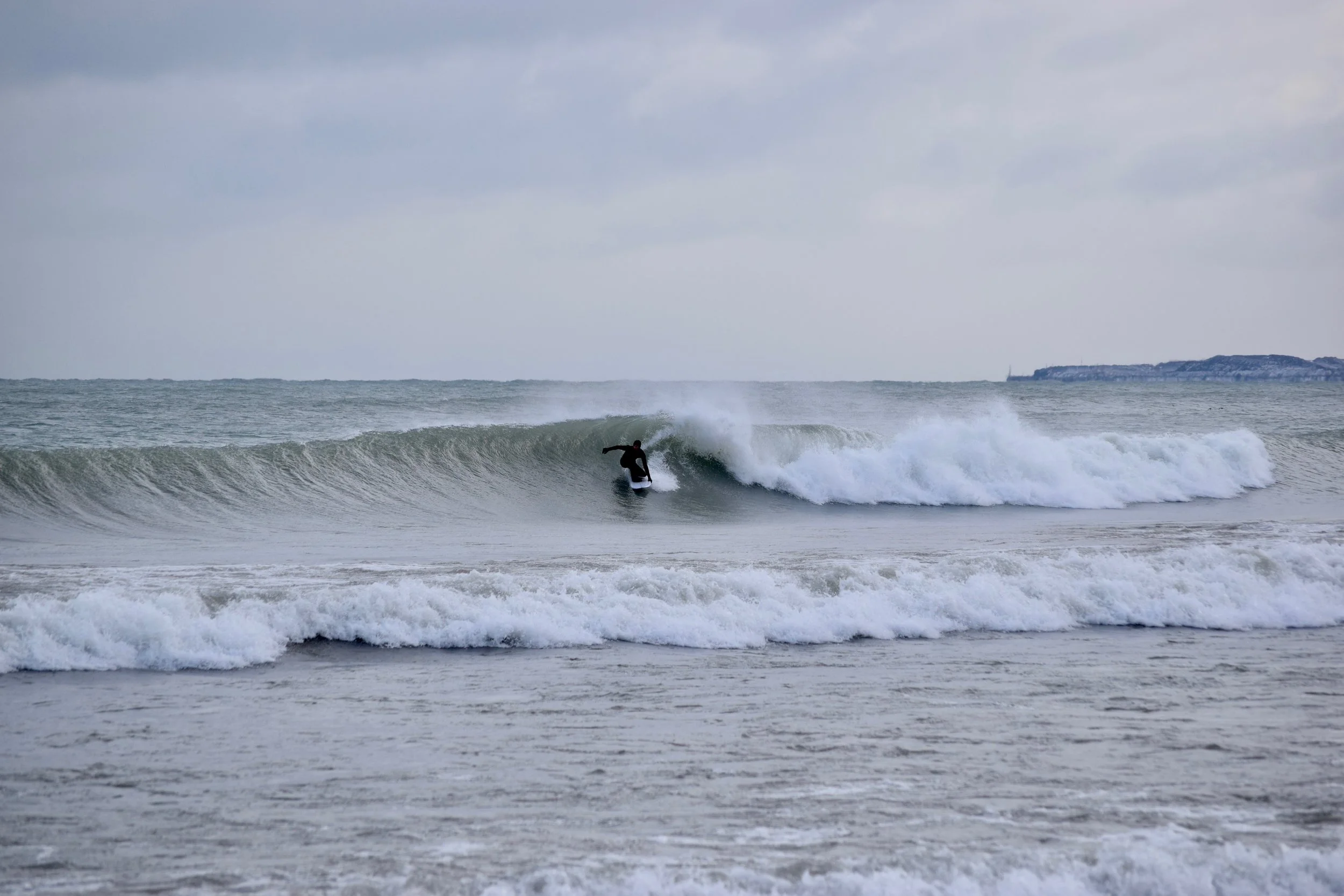
When I moved back from San Diego, I knew people surfed the Great Lakes. I’d seen the ice beards, the annual double overhead Lake Superior swell that makes the rounds on Instagram, Ben Gravy’s videos, etc.
But I had no idea what the surf was like on a regular basis. Is it real surfing? Or is it a novelty you tolerate because you live here now?
What is an average swell like as opposed to the one day a year that ends up passed around social media? How many days a year can I surf?
I was worried I'd get maybe five days a year and spend the rest of the time looking at clips from California. Or I'd end up on a longboard most days, and I am decidedly not a longboarder (nothing against it, it’s just not my thing).
Some of that turned out to be true. But a lot of it didn't.
If you’re used to the ocean, the waves here probably won’t be as exciting to you as waves in the ocean are. You'll drive a lot further for a lot less than you would on the coasts on most days.
However, there are much better waves on the Great Lakes than most people realize. Clean, chest-to-head-high swells happen far more often than you’d think. And more often than not, there isn’t anyone on them.
Here’s the guide to finding and surfing the best waves the Great Lakes have to offer that I wish I had when I moved back.
The Great Lakes’ surf seasons
While each of the Great Lakes has their own preferred wind direction for producing good waves (more on that later), the surf season is pretty much the same across all five of them.
There’s a long technical explanation for why this is the case, but the short version is that the colder the air is relative to the water, the more efficiently wind transfers its energy into the water to generate waves.
So as the air cools down in the Fall, waves start picking up. And since we get the coldest air in the winter, we get the biggest waves in the winter.
Here’s what to expect in greater detail, season by season.
Prime Season: Fall (September – November)
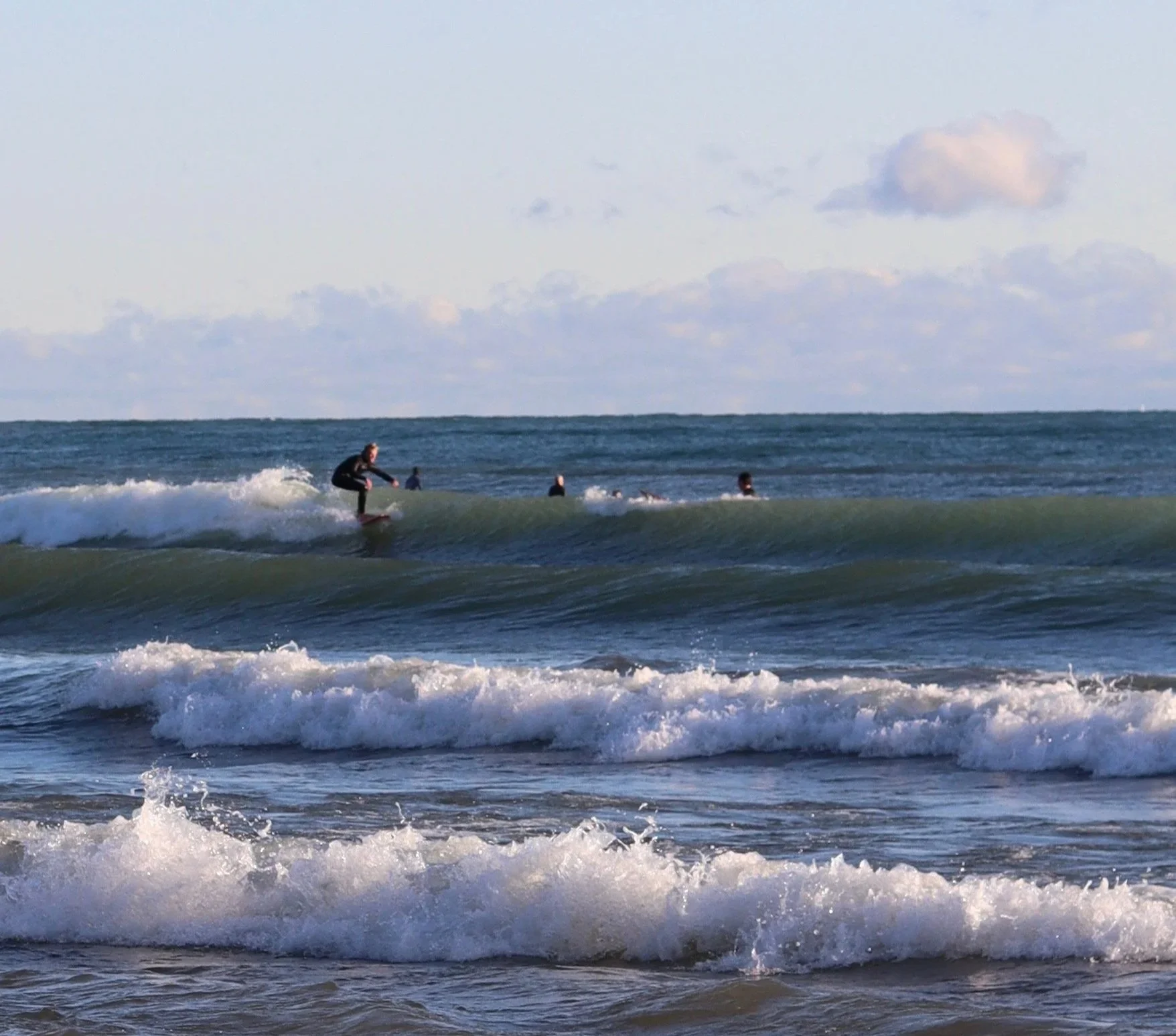
A small Fall day on Lake Michigan.
Fall is the best time to surf the Great Lakes. The waves are the most consistent this time of year and good days run chest to head high and better as frequently as 2-4x a month.
Water temps are still holding onto summer while the air is dropping fast. You're not in full suit of neoprene armor fighting ice yet and everyone in the water is stoked to be there. September and October are my favorite months to surf the Lakes.
If you're new to this and trying to figure out when to start, start in the fall. You'll get more waves, you'll be more comfortable, and you'll actually enjoy learning how the lake behaves instead of just enduring it.
Best Waves: Winter (December – March)
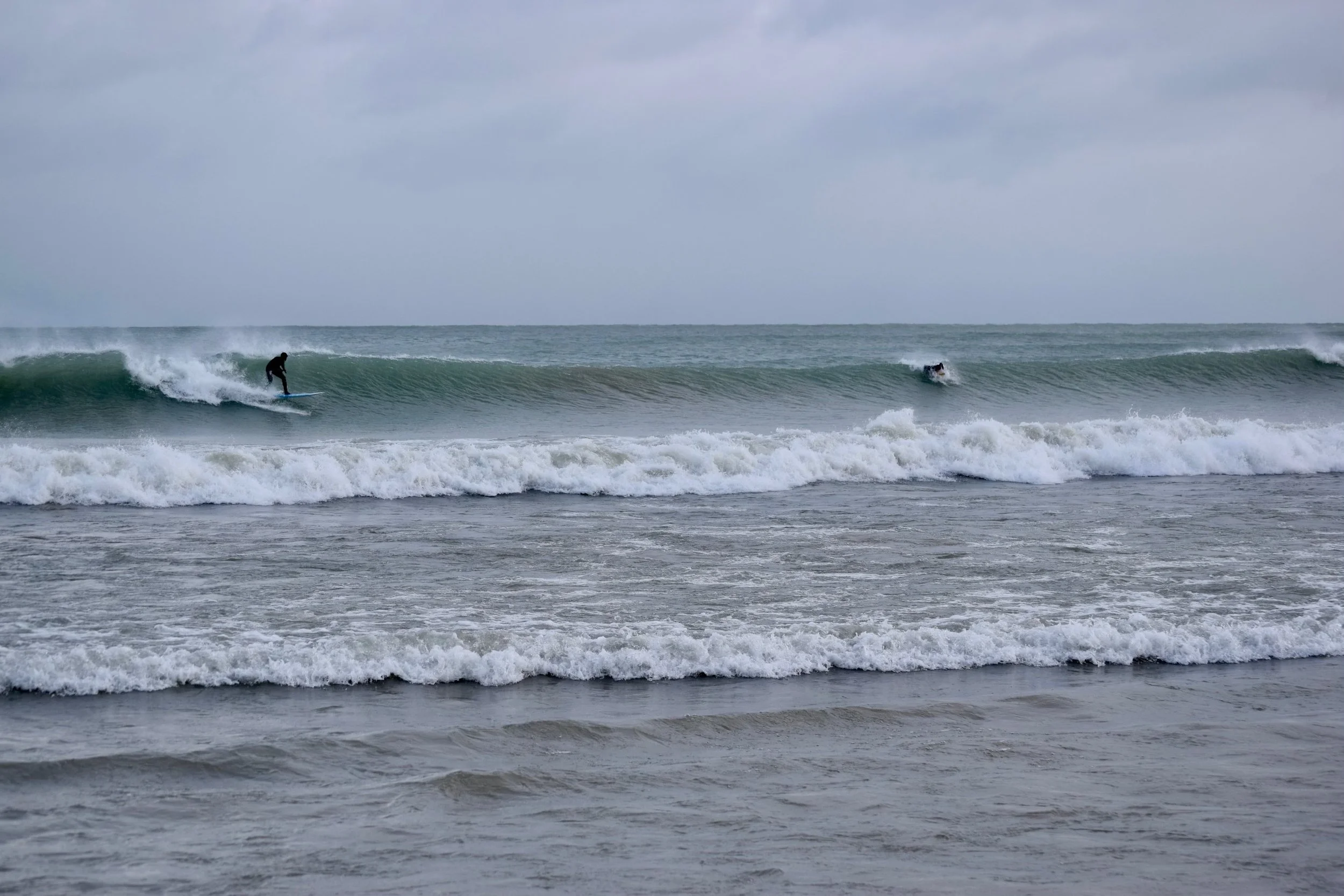
As good as it gets at Chicago’s best surf spot in the middle of January.
Fall is the best season, but winter without question has the best waves.
Some of the best days I've ever seen on the lake have been in January and February — solid, organized, 4-5ft swells are common. And occasionally (maybe once a year), you get stuff that’s even bigger.
But you will earn every single session this time of year.
The water is hovering right around freezing. You need a 6/5 hooded suit, 7mm boots, 7mm gloves, and a genuine tolerance for being cold. Even then, you're getting about an hour before you're done. And on plenty of days your surf break is frozen solid.
So you surf less in the winter than you do in the fall. But when you do get it, it's usually really good.
Shoulder Season: Spring (April – June)
Spring is the inverse of fall in terms of surf, because in spring you get warm air over cold water — literally the opposite of what you want.
It's not that you can't find waves in the spring. It's that you only get them on the days that still feel like winter — when a cold front punches through and briefly restores the air-water gap (around here we call that Third Winter).
Meanwhile the water is still cold enough to require a serious wetsuit well into May, sometimes June on the northern lakes. You're wearing your winter kit to surf small-ish waves in what everyone else is calling spring.
Best Vibes: Summer (July – August)
Like most places in the world, good waves are not super common in the summer around here. Any swell you get typically tends to be short-lived, small, and pretty soft.
But the flip side is that when something does show up, you're not freezing your ass off and usually surfing with a bunch of people who are genuinely delighted to be there. It's honestly pretty great, even though it’s usually small.
Waves on the Great Lakes: what to expect
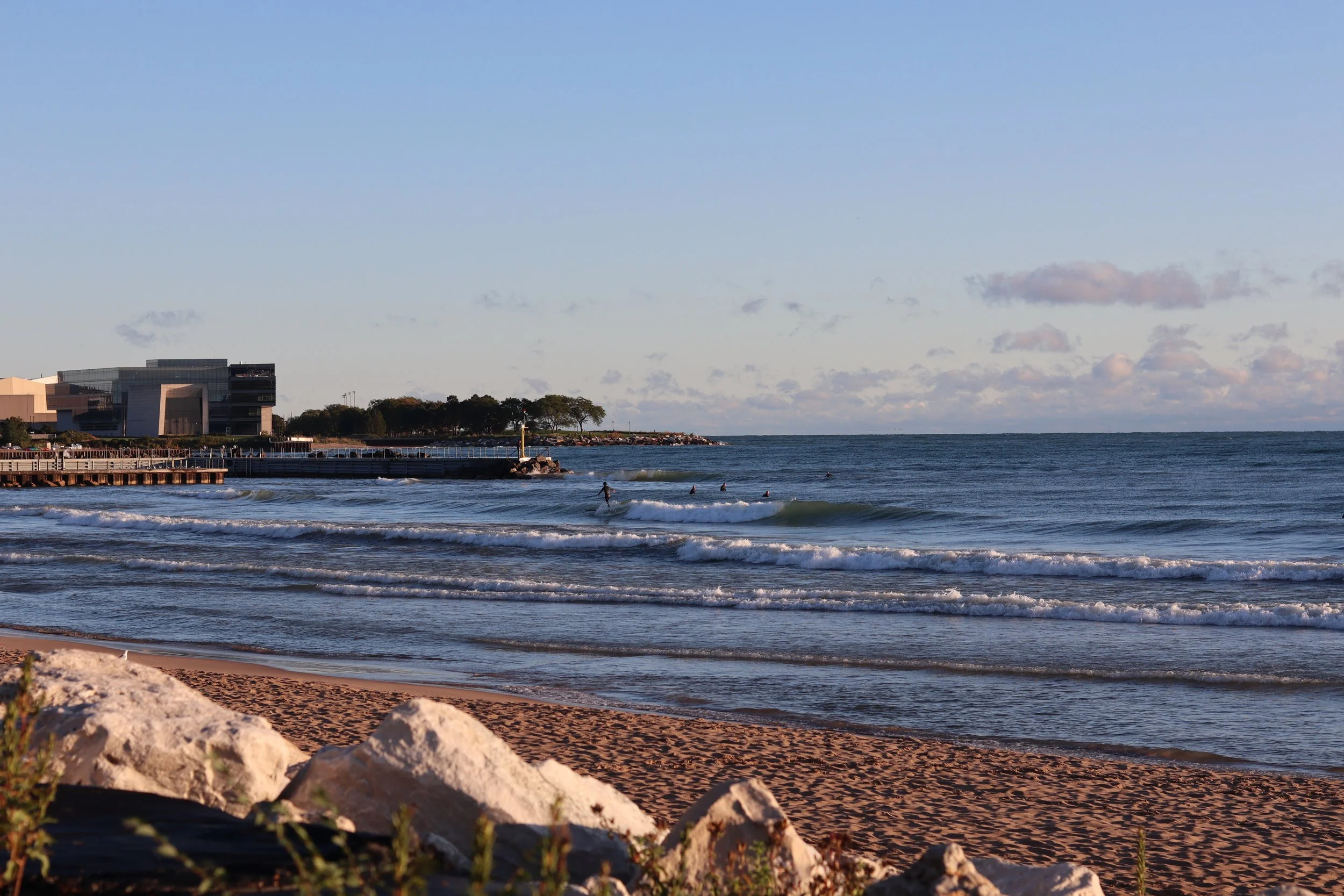
This is on the small side of average for this spot on most days we have swell.
The waves on the Lakes are typically smaller, softer, and messier than the ocean.
We only get windswells. On a really good day, we might see an 8 second period, even if it's overhead. Once a decade, we might see double digits.
Size wise, a good in season swell is typically chest to head high and shows up 2-4x per month. A really good winter swell can push into the double overhead range, and occasionally much bigger if you’re up on Superior. Those swells happen maybe 3-6x per winter when the Lakes aren’t frozen solid.
It’s real surf, just with the juice turned way down.
Swell frequency
If you go on Reddit and ask how many days a year you can actually surf the Great Lakes, you'll get answers ranging from "three or four" to "I surfed 110 days last year."
And here's the thing — nobody's lying. They're just answering a different question, because "surfable" doesn't mean the same thing to everyone.
I'll out myself here: I'm not out there as much as the hardcore lake crew once November hits. I spent years in San Diego surfing knee-high waves and it just doesn't excite me anymore — not enough to freeze my ass off for. So I mostly go when it's chest high or better or when I just need to get wet.
And once the New Year’s hangover is in the rear view, I’m usually booking an Uber to O’hare International to catch a flight somewhere warm until May.
Then there are people like @arenzy who surf everything — big or small, warm or cold. Watch his Instagram clips for ten minutes and you’ll get a good sense for what regular sessions on the Lakes look like.
Neither of us is wrong. We just have different thresholds.
(To be fair, @arenzy also has better waves on average up in Sheboygan than I do down here in Chicago, but I digress).
So the honest answer to "how many days can I surf here" is that it depends on what “surfable” means to you and how much effort you're willing to spend tracking down surf that meets your threshold for paddling out.
The right surfboard can genuinely move that threshold for you — and you don’t have to ride something huge. I'll get into that later on, but it's the single biggest lever you've got to boost your session count, besides learning how to forecast waves.
Forecasting Surf on the Great Lakes
I've written a full breakdown of how to accurately forecast surf on the Great Lakes, so I won't repeat all of it here. But the TL;DR version is that you need to forecast the wind, not the waves. And that’s because the Lakes are much smaller than the ocean.
In the ocean, a good groundswell is created by a storm near one of the poles and then travels thousands of miles to your surf spot.
By the time it gets to you, the storm that created it is long gone, which is why you can surf clean, organized waves under blue skies with no wind at all.
That doesn't happen here on the Great Lakes because in order for there to be enough wind to generate surfable waves, the storm that creates them has to be on top of you.
So around here, when the wind blows, the waves show up downwind, right then, in real time. When the wind dies, the waves die with it. There's no delay and no swell arriving after the fact.
Which means two things:
The wind is always onshore (unless you play the angles — more on this later later). Since the waves are created in real time wind, the waves are always in the same direction as the wind.
The average swell window is very narrow — often 3-6 hours. And when that window is done, it is done. As soon as the wind switches off, the waves die almost immediately. So if you miss the window and you've missed the swell.
Occasionally, in season, we’ll get swells that last more than one day in a row. And those are the really good swells, because when the wind blows in one direction for multiple days, there’s often more power behind the waves.
Ditch Surfline, use NOAA’s free GLERL tool
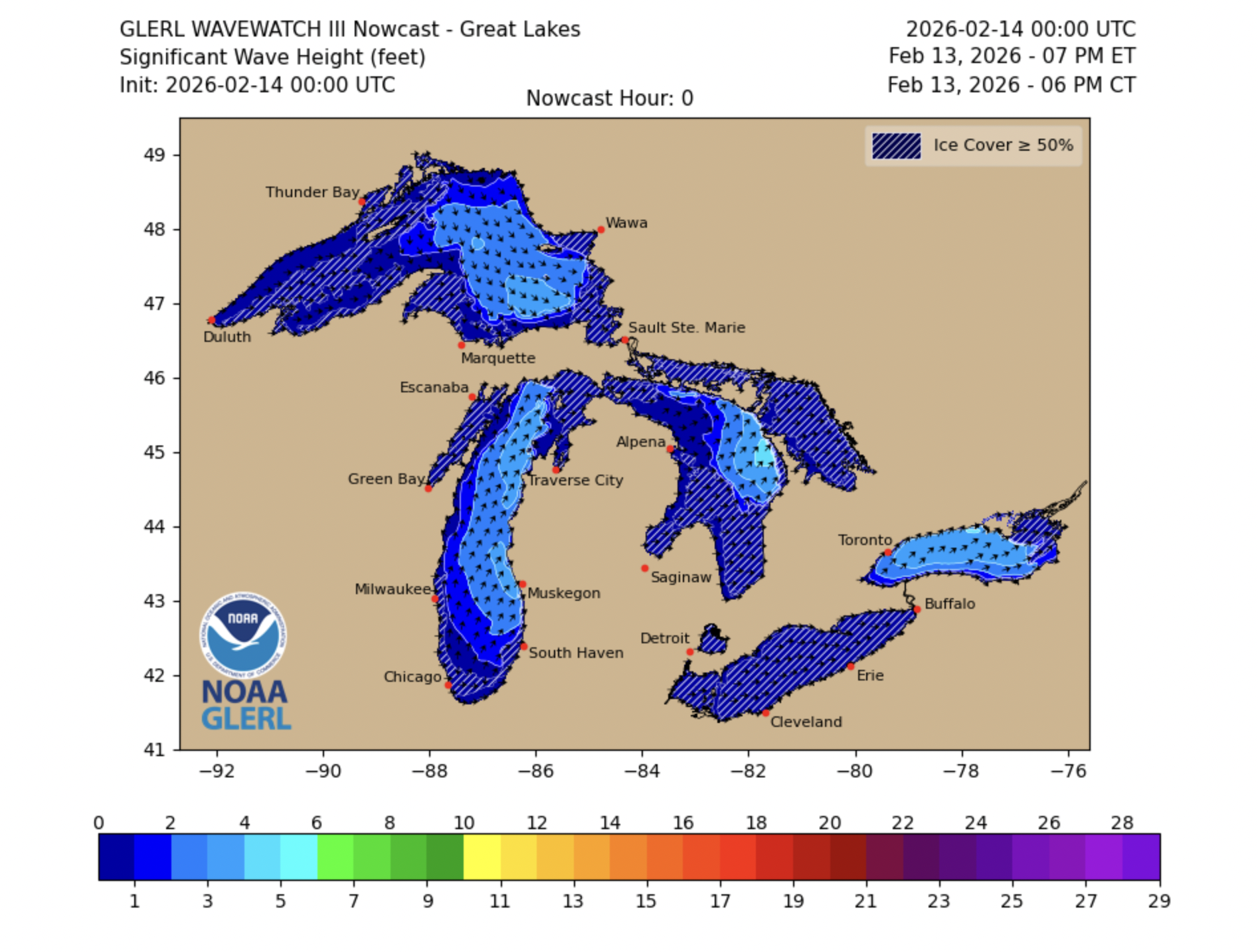
Surfline is built around swell that already exists. A storm forms, the swell leaves it, and days later it shows up at your beach 7-10 days later. That travel time is most of what makes ocean forecasting accurate, and Surfline is very good at it.
The Lakes don't work that way. The storm is on top of you and the waves arrive the same afternoon, so there's no traveling swell to track. They're the same event. Which means predicting lake surf is just predicting wind, and any wave model you use is a wind forecast wearing a costume.
That’s why I prefer to use NOAA’s GLERL tool. It's free, built specifically for the Great Lakes, runs more directly off of what the wind is likely to do in the next 48 hours.
That said, I don't count any forecast as "locked in" until the morning of. A wind event might swing east or west overnight and miss your spot entirely, even if it looked promising the night before.
It's all part of it.
Swell patterns for each of the Great Lakes
Each of the Great Lakes is a different shape, sitting at a different angle, with a different depth, in a slightly different climate. So while weather in this part of the world generally moves west to east, the ideal wind direction for surf is a little different on each of the Lakes.
A lake whose long axis runs east-west has its maximum fetch pointing the same direction the weather is already moving. A lake whose long axis runs north-south does not.
Superior, Erie, and Ontario are the first kind. Michigan and Huron are the second.
Once you understand this, you can start to recognize weather patterns that create ideal swell conditions and make a reasonable guess about which parts of the shoreline are likely to produce the best waves.
Here are the specifics for each of the Lakes.
Lake Michigan
Lake Michigan has its largest fetch running North to South. And while that might seem to conflict with prevailing weather patterns for swell, it’s a big part of the reason Lake Michigan is one of the most surfed lakes.
A low pressure system doesn't blow in one direction — it rotates. As a storm tracks past you, the wind swirls counterclockwise. Ahead of it you get winds out of the south. Behind it you get winds out of the north and northwest.
On Lake Michigan, that rotation means the most powerful waves are typically found on the north and south ends of the lake, unless the north or south winds have an angle to them (which they often do). In which case, waves will hit the central Michigan or Wisconsin/Illinois coast.
In practice, this means if you're on the south end of Lake Michigan, you want the back side of a low pressure system. If you're on the north end, you want the front side.
Lake Michigan also tends to freeze over less than most of the other lakes, which means you get a decent winter surf season. This past February, when Lake Erie was at 95 percent ice cover, Lake Michigan was sitting around 34 percent.
Lake Superior
Superior is the biggest, deepest, and most northern of the five lakes and gets the most ocean-like waves as a result.
To put it in perspective, in October 2017, a research buoy near Munising recorded a significant wave height of 28.8 feet sustained over an hour — meaning the average of the largest third of waves was nearly 29 feet, and there were likely individual waves in the 30 to 40 foot range mixed in
Long story short, when you see clips of lake surfing that you can’t believe is lake surfing, you’re probably seeing clips of Superior.
Superior, like Lake Michigan, has the advantage of a long uninterrupted fetch of 300+ miles. Except on Superior, it runs west to east, just like the prevailing weather patterns.
As you would expect, the east side of the lake gets pretty big surf. But the west side does too, depending on whether the low pressure system passes south of the lake or north of the lake.
When the low pressure system passes below Superior, it generates wind out of the northeast, which creates waves on the west coast of the lake. When it passes above Superior, the wind blows west to east, generating waves for the east coast of the lake.
Lake Huron
Lake Huron, like Lake Michigan, has its predominant fetch running north to south (the main basin) and reacts to low pressure systems very similarly to Lake Michigan. The fetch is about 100 miles smaller than Lake Michigan though.
The bays (Georgian and Saginaw) are quite a bit smaller than the main basin and have their own wave generating patterns. I don’t know much about them, as there isn’t a lot of information online about it and I haven’t surfed either of them (or Huron for that matter).
Lake Erie
Erie runs 241 miles from west-southwest to east-northeast, which is almost perfectly aligned with prevailing weather patterns. When it blows out of the west/southwest on Erie, the wind has the entire length of the lake to work with, and it stacks everything into the eastern end — Buffalo, the New York shoreline, Presque Isle.
Erie is also the shallowest of the Lakes, averaging only 62 feet deep, which makes wave generation on Erie quite a bit different than the other Lakes. Studies have found that any sustained winds of 30mph actually generate waves that break out in the middle of the lake.
For surfers, this means that the waves but do not carry as much power as the other Lakes. And it means that the swell windows are much shorter, because the lake bed drains the energy out of them faster as soon as the wind dies.
Erie also freezes over quickly in the winter due to how shallow it is — often over 80 percent. So that means your winter surf season on Erie is generally shorter than everyone else's.
Fun side note: Erie actually has real surf history. The Wyldewood Surf Club in Port Colborne, Ontario has been going since 1965 — the oldest surf club on the Great Lakes, and still active.
Lake Ontario
Ontario is the smallest of the five lakes by surface area with a maximum fetch of 193 miles east to west — right in line with prevailing weather patterns.
Researchers looking at 36 years of extreme wave events on the eastern shore of the lake found that the biggest waves come from a low pressure system that tracks north of the lake, moving up from the Ohio Valley. So if you’re surfing Lake Ontario, that’s the weather pattern to look for.
Interestingly enough, Ontario also follows a slightly different seasonal pattern than the other four. The biggest waves typically peak in autumn and spring, but it’s most consistent in winter. And, it also tends to freeze over less than the other Lakes, meaning your winter season will generally be longer.
How to find clean, surfable waves on the Great Lakes
The reason I’ve spent so much time talking about meteorology, wind direction, etc. up until this point is because the only way to find waves that are actually clean here is by knowing where the weather/wind is coming from.
Because the wind and waves show up together, a change in wind angle can mean the difference between blown out, glassy, and flat. And sometimes they all happen at the same spot on the same day.
Here’s how I use wind and weather data to find clean, surfable waves on the Lakes.
1. Start with GLERL
The first thing I do when I’m planning a surf session is look at GLERL about two days out.
I’m checking 2 things:
Whether there will be waves at all
What angle the wind/waves are supposedly coming in at
Two days is about as early as you can reliably predict a swell around here. Further out and the weather forecast isn't reliable enough to plan around.
I don’t count it as locked in until the night before (and quite often, the morning of).
2. Look for protection
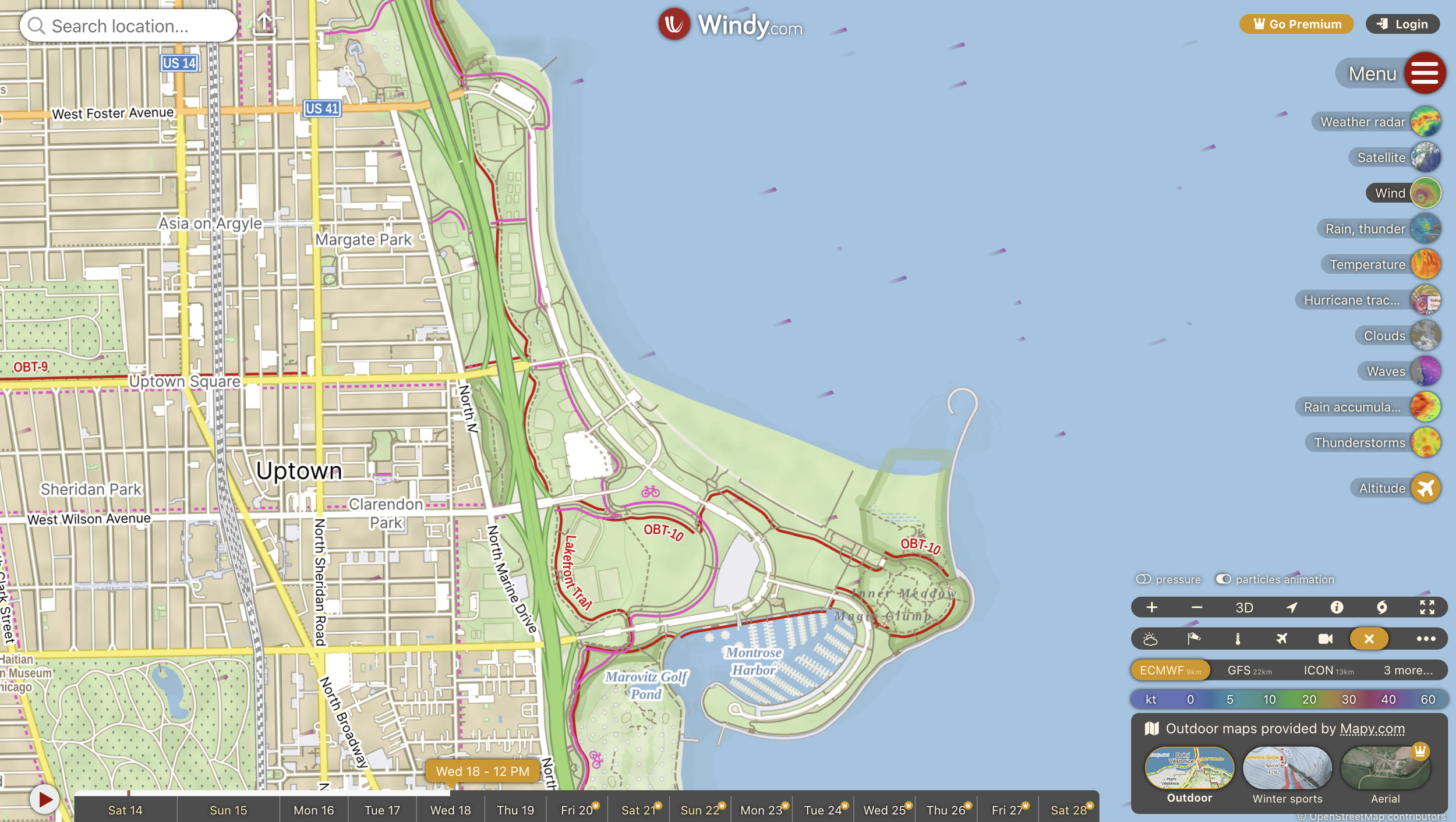
On the lakes, exposed shoreline is usually a churned-up mess when there's any real size. So what you want to find is a corner. Something jutting out that blocks the wind or at the very least, angles it ~90° to the beach.
Just enough to clean up the surface a bit, and give you more organized waves in the lee of the structure.
If the waves are hitting in a place I’ve never surfed before, I open up Google Maps, go to satellite view, and look at the coastline that's going to be receiving the swell.
I’m looking for anything that sticks out into the water to the direction the wind/waves are coming from. Jetties. Piers. Breakwalls. Points. Peninsulas. River mouths. Harbor entrances. Man-made or natural, doesn't matter. It just has to be at an angle to the primary wind/swell angle.
Structures like this also do a second useful attribute: they catch sand. Anything that interrupts the longshore drift builds a sandbar on one side of it, and sandbars are what turn a wall of windswell into something that actually breaks properly.
My favorite spot in Northwest Indiana is a genuine 3-turn left hand point break once it hits chest high for this very reason.
3. Check bathymetry on satellite
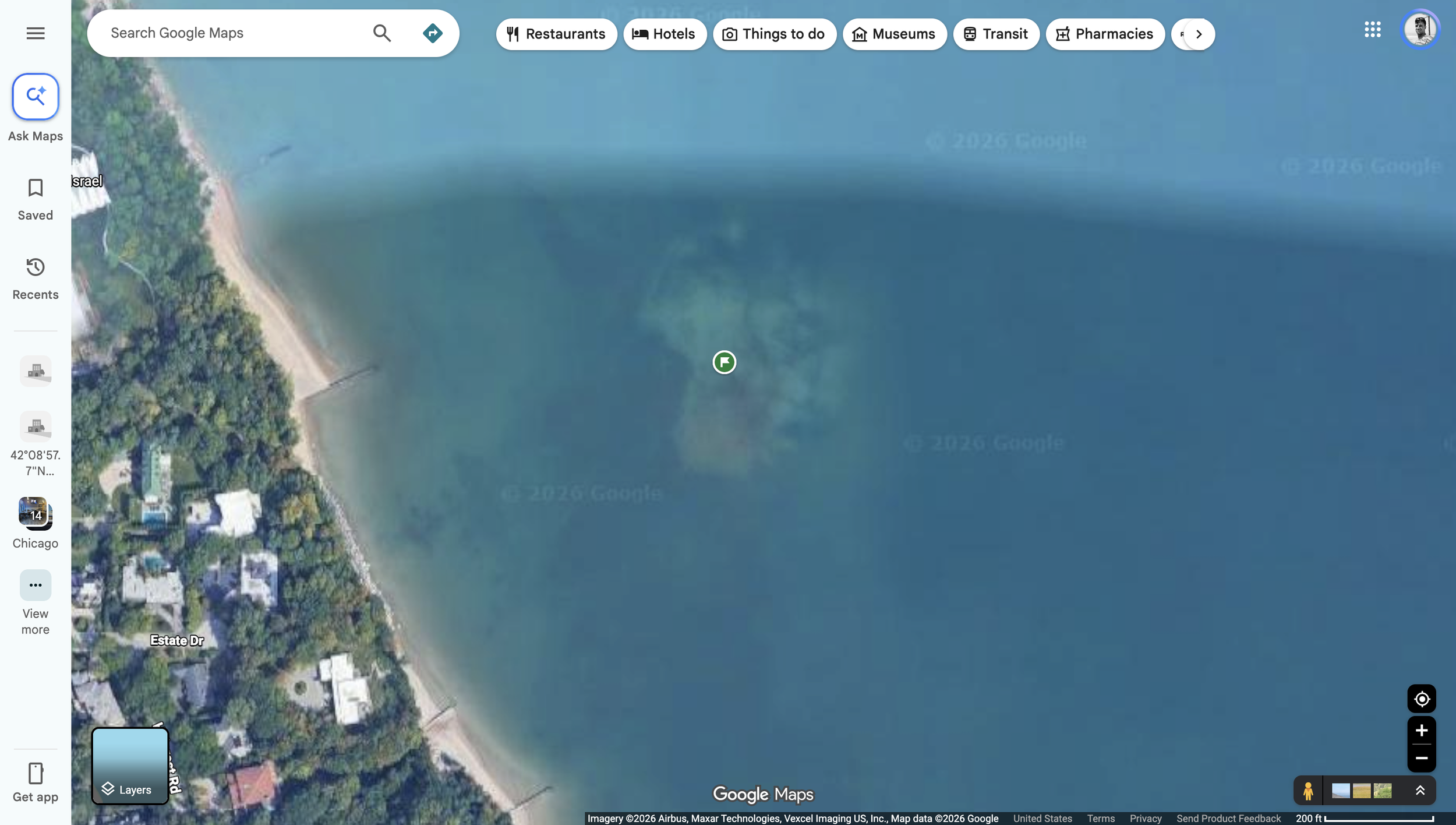
A reef near the Wisconsin-Illinois border that I know produces good waves, but only in very specific conditions.
Satellite imagery of lake coastline (or ocean for that matter) is often clear enough to show you what's underneath the water, especially in the shallows.
You're looking for sand buildup, reef, rock, anything that changes the depth. Lighter colored water is shallower. Darker is deeper. A light patch angling out from shore is a sandbar, and the way it's oriented tells you which direction a wave would peel across it.
You're doing rough bathymetry off a free satellite photo. It's imprecise and you'll be wrong plenty. But it's the difference between driving to a random beach and driving to a beach where you have an actual reason to think something might happen.
And every so often you get lucky and the satellite image catches the lake with swell in it. You'll see actual lines running toward the shore, and you can see exactly how they bend and where they focus. When you find one of those, you've basically been handed the answer.
The best surfboards for Great Lakes waves
People ride everything on the lakes and have a great time doing it.
But for most surfers on most days, a midlength or a longboard in the 7'0" to 9-plus range is the best all-around choice. These shapes have the surface area, the foam, and the rocker profile that suit our conditions, and a board in that range can genuinely be a one-board quiver for everything the lake throws at you across the seasons.
I've never had a session ruined by bringing too much board. I've had plenty ruined by not having enough. Foam is your friend on the lake. And it’s not because of the lack of salt.
While yes, the lack of salt does mean your average ocean surfboard will sit lower in the water, that only really affects you when you’re paddling around the lineup or when you’re scratching for a wave.
Once you’re up and riding, hydrodynamic lift takes over. And the amount of lift is determined by the speed/power of the wave itself. In other words, the surfboards that work well on the Lakes are the ones that are best suited for small, soft ocean waves. Grovelers, hybrids, midlengths, longboards, funboards, etc. all work well here.
I typically go about ¼” thicker and 1” wider on my Lake boards and push a little more foam out towards the rail. Most days, I’m on a 7’6” - 8’0”. On the better days, I’ll surf something in the 6’2” - 6’10” range (for reference, I’m 6’3” and 210lbs dry).
If you’d like to learn more about choosing a surfboard for the Lakes (including the science behind why I’m making these recommendations), I’ve written a full guide here explaining it all in detail.
Wetsuits and survival
If you want to surf here year-round, you need a quiver of wetsuits to match the seasons.
The exact amount of rubber you’ll need will depend on which lake you’re on (and which part of that lake you’re on). But here’s what I typically wear across the seasons on the southern most tip of Lake Michigan:
Summer, July through August. Boardshorts and rashguard. Maybe a 1mm top if I’m out for a while or the air is below 70°F for the day.
Early fall, September into October. A 1mm top to start, moving to a 3/2 as the air drops. This is the most comfortable stretch of the year — water still holding summer heat, air getting crisp. It's why fall is the best season out here.
Late fall and early spring (October into November and April into May). A 4/3 with a hood, 3mm gloves, 5mm booties. This is the workhorse setup and it covers a lot of the calendar. If you're only buying one serious suit to start, buy this one.
Winter, December through March. A 6/5 hooded suit, 7mm boots, 7mm gloves. Full neoprene armor. Ice beard season.
One thing I'll add that caught me off guard when I moved back: the wind chill is a real factor here because the air is always colder than the water if you’re surfing. So when in doubt, pack extra rubber.
Ice shelf safety
When you show up to surf on a winter day and there's an ice shelf between you and the water, the instinct is to scramble across it and jump in.
Don't. These ledges look solid, but are frequently hollow underneath, with moving currents beneath them.
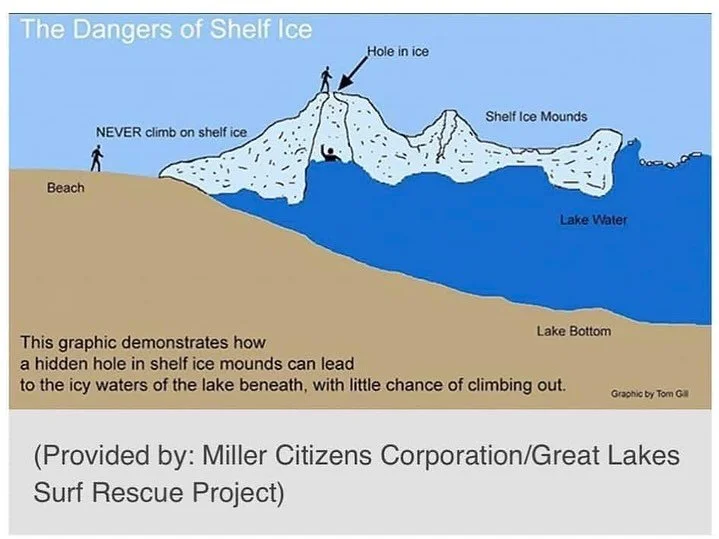
Instead, look for a clear entry and exit point where you can get in and out of the water without crossing significant shelf ice.
Sometimes that means walking a few hundred yards down the beach. Sometimes it means the spot isn't surfable today and you drive somewhere else.
Surf culture and community on the Lakes
Surf culture here is great. People are friendly and genuinely glad to see you in the water. Some of it is just because it's the midwest. But a lot of it is because most surfers here are grateful to discover they're not the only ones who surf.
We're surfing a freshwater lake in the middle of North America, in conditions most of the world doesn't know exist, in water that's frequently near freezing half the time, often on waves that a lot of surfers wouldn't get out of bed for. People tend to bond over that.
So show up, introduce yourself, and be normal. Occasionally you might run into a knuckle head or two who thinks they’re surfing Pipeline, but generally, people will be glad you're there.
Surf shops/community hubs worth knowing about
There aren't many surf shops here, and they’re usually the only community surf hub for a couple hundred miles in any direction. So if you're near one, check it out, talk to people and buy local.
Here's are a few notable shops worth checking out:
EOS Surf & Outdoor — Sheboygan, Wisconsin (Lake Michigan). Wisconsin's first and only dedicated surf shop. Boards, rentals, and lessons, in a town with real surf history — Sheboygan has been calling itself the Malibu of the Midwest for decades.
Sleeping Bear Surf & Kayak — Empire, Michigan (Lake Michigan). The north end of the lake. They run a shred camp that's popular enough to sell out almost immediately.
Edgewater Surf — Cleveland, Ohio (Lake Erie). Ohio's only dedicated surf shop. Boards and lessons.
The Back Alley — Duluth, Minnesota (Lake Superior). Surf shop and coffee, and the hub for the Minnesota North Shore scene.
Down Wind Sports — Marquette, Michigan (Lake Superior). Not surf-specific, but they're deep in the Marquette outdoor community and they publish a genuinely useful local break page.
Surf Ontario — Toronto (Lake Ontario). Online rather than a storefront, but they run a Great Lakes surf report.
If there are any I missed that you think I should be on this list, hit me up and I’ll get them/you added!
Surfing the Great Lakes is what you make of it
I've tried to approach this article as neutrally as I can. I'm not trying to convince you the surf on the Great Lakes is epic or pretend it's something it isn't. They’re lakes, after all.
But they do have their days. And if you’re willing to take the time to figure out how they work, I promise, as a once former skeptic — you’ll have fun on those days.
Here’s what I’ll leave you with: there are over ten thousand miles of coastline across the five Great Lakes. And most of those miles are completely unexplored from a surf perspective.
There are undoubtedly great waves waiting to be found here — all it takes is someone willing to put in the time and energy to find them and show up when the swell hits.
Whether that sounds like fun or not is up to you.
Cheers,
Scott